Showing posts with label Gas Detection. Show all posts

The MSA ULTIMA X5000 Gas Monitor

X5000 Gas Monitor
The ULTIMA® X5000 Gas Monitor is the future of gas detection for oxygen, toxic and combustible gases. MSA XCell® gas sensors with TruCal® technology offer calibration cycles up to 18 months (local calibration respected). The gas transmitter's advanced, multi-lingual OLED display is easy to read and the unique touch-screen interface makes it simple to navigate.

X5000 Gas Monitor Features:

  • Bluetooth wireless technology
  • Check status and get alerts up to 75 ft. (23 m) away 
  • Modify settings/setpoints/alarms
  • Initiate calibration and view progress
  • Reduce setup time by at least 50%
  • Up to 1.5 YEARS between calibrations!
  • Adaptive Environmental Compensation (AEC)
  • 12+ Patents
  • 5 Yr. Expected Life
  • 3 Yr. Warranty

DOWNLOAD THE ULTIMA® X5000 BROCHURE HERE


For more information on the ULTIMA® X5000, contact Power Specialties, Inc. Call them at (816) 353-6550 or visit https://powerspecialties.com.

Recorded Webinar: Detection Technologies for Toxic and Combustible Gases


This recorded webinar, presented by MSA, provides an excellent overview of the history of gas detection and the technologies used today. MSA is the world's leading manufacturer of safety products designed to protect people throughout the world.

Industrial gas detectors are used in a wide variety of chemical plants, refineries, water treatment plants, and other manufacturing facilities to continuously monitor and detect toxic or combustible gases and vapors. They are equipped with audible and visual alarms to alert personnel to the existence of these conditions.  The major components for industrial gas detectors are the sensor, the detector, the transmitter, and the annunciator.  Gas detection systems are available as single point sensing or multiple point sensing capabilities, and in fixed position or portable configurations.

For more information about MSA gas detection products, contact Power Specialties. Call them at (816) 353-6550 or visit them at https://powerspecialties.com.

The MSA PrimaX Gas Monitor

PrimaX Gas Transmitter
Indoors or outdoors, the PrimaX Gas Transmitter provides dependable, accurate gas detection. The transmitter detects toxic gases and oxygen and is housed in an antistatic, reinforced nylon enclosure. It also has a large, easy-to-read LCD screen and attaches to an integral mounting plate for easy installation, while the built-in keypad makes for quick, simple calibration. To transmit data, the unit uses a 4-20 mA output signal and can also be configured to use HART digital communication. With easily replaced plug-in sensors, the PrimaX I transmitter is suitable for laboratories, chemical plants, power plants and several other industry settings.

For more information on the MSA PrimaX, download the presentation at this link, or contact Power Specialties by visiting https://powerspecialties.com or calling (816) 353-6550.

The MSA Ultima X5000 Gas Monitor

MSA Ultima X5000 Gas Monitor
The MSA ULTIMA® X5000 features a new design equipped with an Organic LED (OLED) display and bright status LED’s for extreme visibility. The gas monitor employs Green, Yellow and Red LED’s to signal normal, fault and alarm conditions.

Dual sensing technology doubles the sensing power with half of the footprint of a single gas transmitter. Sensors can be remotely mounted, mixed and matched to suit your gas detection needs.

Bluetooth wireless technology allows you to use your mobile device as an HMI screen and controller. The X/S Connect App is designed with high security standards and provides real-time information to your mobile device. Reduces setup time by at least 50%.

MSA’s patented XCell® sensors with TruCal® technology, extends calibration cycles up to 18 months. TruCal technology actively monitors the sensor integrity and compensates for environmental factors that cause regular electrochemical sensors to drift, allowing calibration cycles to be extended well beyond industry standards. TruCal can greatly reduce downtime and provides peace of mind.

https://powerspecialties.com
(816) 353-6550

More Reliable Gas, Vapor and Flame Detection

Human Sensory Model Gas Detection
Understanding the Human Sensory Model of Gas Detection
(courtesy of MSA)
Chemical plants, refineries, processing plants, and storage facilities contain large indoor and outdoor areas that include congested arrays of complex equipment, such as tanks, pumps, pipelines, and valves. Detecting combustible gas leaks and flames in these areas can be a real challenge - even under the best of conditions. Protection from accumulating gases or unnoticed flame depends on sensors that quickly alert you to their presence. If the gas, vapor, or flame goes unnoticed, lives and property are put in danger.

Legacy sensors traditionally relied on the "sense of smell" to detect minuscule amounts of gas emanating from a leak. There's a problem with this approach though. If a leak doesn't contact the sensor, it can go undetected, leaving you unaware of a potentially critical situation. Situations whereby leaks are prevented from reaching a detector are not uncommon and are further complicated by the physical layout complexity of a room or area. Gas and vapor leaks are affected by ambient conditions, and properties such as the density of the leaking material, the surrounding ambient temperature, and nearby air flow (such as wind or breeze) all impact the detection strategy.  Irrespective to the number of traditional sensors installed, these conditions jeopardize the reliability of the detection strategy.

Human Sensory Model

Given these difficulties, a recent strategy in gas and  flame detection has emerged for use within industrial plants. A practice referred to as "The Human Sensory Model" presents a more reliable system for gas, vapor, and flame detection. This model uses "layers" of monitoring and detection in hazardous environments, with smell based detectors being one of the layers.

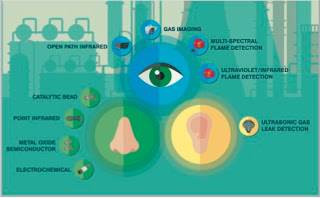
The layers of detection include several additional technologies, that together, mimic the human sensory system of smelling, seeing, and hearing.  Integrated optical infrared gas sensors, along with gas imaging and optical flame detectors allow detectors to see a leak or flame, while catalytic bead detectors “sniff” for gases, and ultrasonic sensors “listen” for escaping gases. These detectors react in ways resembling those of human beings (hence the name) and use the combined intelligence of multiple inputs. Through layering sensor technology, a plant can achieve a much more reliable chain of defense against hazardous gases and flames.

Always consult an application expert before specifying or installing gas and flame detection equipment. Their expertise will help ensure a safe and reliable outcome.

For more information, contact:

Power Specialties Inc.
(800) 432-6550
https://powerspecialties.com

The Truly Universal Approach to Gas Detection. Design, Implementation and Maintenance

Universal Gas Detection
Truly Universal Approach to Gas Detection
Reprinted with permission from an article titled

Executive Summary

Protecting your people and your physical plant, while ensuring business continuity, are the most important functions of a fixed gas detection solution. Engineering a reliable, high-performance system that makes it easier and more cost effective to meet this challenge is the driving force behind a truly universal approach to gas detection. 

This white paper is about the evolution and benefits of designing, implementing and maintaining a truly universal approach to gas detection. Our intention is to help you use this information, based on “universal truths,” to evaluate your current system and project the impact of next-generation gas detection on your organization’s safety and productivity in a global economy.

Introduction 

In a global economy, the challenges to personal safety, productivity, and business continuity are magnified. Companies in a wide range of industries, where the presence of combustible and toxic gases are a way of life, must continue to evaluate their gas detection systems or pay the price on many levels. This evaluation must consider a number of factors that can enhance safety, while streamlining installation and minimizing maintenance – in the present and the future. That’s what constitutes a truly universal solution. 

Fixed Gas Detection with Legacy Technology/Instruments 

Before we look ahead and evaluate a truly universal approach, it’s important to take a look at how gas detection is done with legacy technology today…
  • a single detector is paired and tested with a single sensor, detecting only a single combustible or toxic gas; 
  • adopting new, advanced digital communication protocols necessitates replacing existing systems with new detectors and/or new sensors; 
  • unique certification requirements for different devices and regions complicate the ability to engage in business as a company expands its operations globally; • more points mean more maintenance and associated costs; 
  • a field technician’s toolbox is packed with multiple sensors, detector heads and accessories from multiple manufacturers, requiring major inventory investment; 
  • a large workforce with specialized knowledge is needed to address specific installation and service requirements; and multiple manuals, covering many different product lines, only complicate installation and impede productivity;
Engineering, Installation and Maintenance for a Universal World 

Call it a paradigm shift in response to customer needs. Today, there is an increasing call for higher levels of safety, performance, standardization, economies of scale, ease of use, and overall accountability. Meeting these needs and adding value to the customer experience begins with re-thinking fixed gas detection engineering. 

Engineering a universal gas detection system provides its own set of challenges. But these challenges are being met and needs are being fulfilled. As you position your company to leverage a truly universal gas detection solution, you must evaluate where you are and where you need to be. The following exploration of legacy systems used in the field today and truly universal characteristics of next-generation gas detection instruments should aid in your evaluation.

One to Many 
  • Legacy System: A single detector is paired with—and tested with—a single sensor, accommodating only a small number of combustible or toxic gases. 
  • Truly Universal System: A single gas detector accommodates multiple sensors, allowing you to detect multiple types of gases in one location. Working within the same device footprint the transmitter is designed to support different sensing technologies: combustible gas sensing with infrared and catalytic bead sensors and electrochemical and metal oxide semiconductor sensors for toxic gases. Using equally smart sensor technology allows the construction of sensors with multiple ranges in the same package which in turn enables range invariant calibration. One instrument that can provide the capabilities of multiple instruments, and one sensor that can support multiple gas ranges provides valuable flexibility not available in legacy gas detection devices. 
Communication Protocols 
  • Legacy System: Legacy systems have traditionally relied on analog signals for communication. This limits the transmission of advanced diagnostics data that ensures a safe plant environment. Adopting digital communication protocols necessitates installing new detectors and/or new sensors. 
  • Truly Universal System: As needs change and new communications protocols are required, universal transmitters are engineered to accept new plug-and-play communication boards. This multiprotocol innovation – wired or wireless (when industry appropriate) – means protocols can be added without replacing the transmitter as a plant’s communication requirements change. You’ll want to make sure your transmitter accommodates a wide range of communication protocols, including Modbus, HART, wireless HART and wireless ISA100.11A. This kind of flexibility is a key to a futureproof gas detection solution, and the transition from rigid, proprietary systems to standards-based, secure systems that accommodate growth and change.
Calibration and Maintenance 
  • Legacy System: Because of engineering constraints, sensor calibration must be performed in the field, where conditions are less than ideal and both safety and performance may be compromised. 
  • Truly Universal System: Accurate calibration is critical to satisfying both safety and performance requirements. It also impacts productivity when false alarms, due to inaccurate calibration, slow down – or even shut down – production. Imagine the consequences of an electrochemical sensor triggering an alarm that releases a blanket of foam. The cleanup costs alone can be staggering!

    Next-generation gas detection enables a calibration-in the-lab scenario, providing a more controlled and safe environment for establishing gas sensor parameters. This is a significant innovation, especially with legacy cat bead sensors which required proper voltage adjustments at the point of detection. Additionally, the flexibility to calibrate an electrochemical sensor to a particular gas level and then make simple adjustments to the range later—without recalibrating the sensor to the new range—can offer significant efficiencies in sensor maintenance.

    Through advanced engineering, a transmitter’s microprocessor can remember the type of sensor installed, as well as all calibration values. This built-in system of checks and balances virtually eliminates duplication of effort and the possibility of installing the wrong sensor. 
Global Standards 
  • Legacy System: Global certification, especially when deploying a variety of detectors, can complicate and delay the ability to engage in business as your company expands its operations. 
  • Truly Universal System: Expanding the certification of a gas detector for global acceptance (including CSA, ATEX, IECEx, INMETRO, GOST-R, China Ex, A & C Tick, Marine Directive - Ship’s Wheel/ ABS and SIL 2 certified by a third party agency), plays a critical role in facilitating quick global adoption. The process of seeking global certifications can be further streamlined when a single gas detector is flexible enough to accommodate a wide range of toxic and combustible gases.
Cost of Ownership
  • Legacy System: The presence of more points (i.e., detectors) means higher maintenance, more complexity and incremental costs associated with added cabling, junction boxes and wiring. 
  • Truly Universal System: Less is more – and better – when you can reduce the number of points in a gas detection system. One device consolidating three points has a positive ripple effect in terms of installation and maintenance. For instance, at a site with 45 points, accepted practice would include point-to-point wiring, using a Modbus communication protocol wired back to a central location or controller. But with a multi-head scenario, handling three points each, the number of detectors is reduced to 15 devices. This approach represents significant cost savings. In fact, using a single detector that consolidates three points, with a single relay board to control three alarms, totally eliminates a costly controller. Multiply this configuration times three for every three-head detector/multiple sensor configuration, and your cost of ownership is further reduced. 
Workforce Knowledge Base
  • Legacy System: Multiple manuals or the knowledge of many different product lines can slow the installation process and impede productivity. 
  • Truly Universal System: In today’s climate, it is becoming increasingly important to do more with a smaller, less specialized workforce. Truly universal engineering produces solutions that are simple to use with consistency in design making products intuitive, easy to learn and easy to use. This reduces installation time and increases productivity. 
Toolbox
  • Legacy System: Large inventories of sensors, detector heads and accessories demand a significant inventory investment. 
  • Truly Universal System: A field technician looks in his toolbox and sees fewer sensors, detectors and calibration adapters, as well as fewer accessories (like deluge guards and flow cells). Universal mounting kits simplify the process in new installations, while retrofits to existing installations are significantly more manageable. This simplification also minimizes lapses in safety due to human error. 
Conclusion 

Exploring a series of “universal truths” about next-generation fixed gas detection is a critical first step in evaluating how you protect your people and maintain the highest levels of productivity. Truly universal gas detection begins with a singularly flexible system, engineered to ensure accurate performance in a wide range of environments; considers current and future manufacturing plant environments; and plays a significant role in keeping costs under control in the face of global certification requirements and a changing workforce. How you use this insight will impact where, and how successfully you conduct business.

For more information contact:
Power Specialties, Inc.
9118 E. 72nd Terrace
Raytown, MO 64133
Toll Free: (800) 432-6550
Phone: (816) 353-6550
Fax: (816) 353-1740