Showing posts with label Yokogawa. Show all posts

Basics of Coriolis Mass Flowmeters

Coriolis Mass Flowmeters

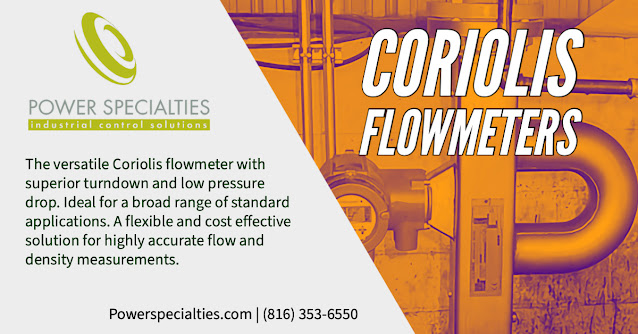
At its most basic description, a Coriolis mass flowmeter is a U-shaped tube that vibrates or deflects as fluid flows through it. This type of mass flow meter is based on angular momentum conservation as it applies to the Coriolis acceleration of a fluid. The tangential force felt when walking radially outward on a rotating platform is known as Coriolis acceleration. The force occurs when one's position with the center of rotation changes. 

Principle of Operation  of Coriolis Mass Flowmeters

Fluid enters the U-shaped tube is forced to move vertically in response to the vibrating tube. The fluid flowing into the meter resists the force by pushing down on the tube when the tube moves upward. The fluid flowing out of the meter, having been forced upward, resists, reducing its vertical motion by pushing up on the tube — the tube twists due to the two opposing forces acting on it. The twist is proportional to the mass rate of fluid flowing through the tube. 

Operation and Major Components Coriolis Mass Flowmeters

A mass flow meter includes a vibrating U-shaped tube that generates and measures Coriolis acceleration. In place of the previously described rotational motion, the inlet and outlet of the tube remain fixed. In contrast, the tube is vibrated sinusoidally about an axis formed between the inlet and outlet, typically by a magnetic device located in the bend. Most devices use magnetic sensors on each side of the flow tube to measure the velocities, which change as the tube twists. 

Coriolis mass flowmeters apply to liquid applications such as harsh chemicals, low to medium viscosity, foods, slurries, and blending systems. Gas applications are somewhat limited because the density of low-pressure gases is usually too low to operate the flow meter accurately. 

For more information about Coriolis mass flow meters, contact Power Specialties by visiting https://powerspecialties.com or by calling (816) 353-6550.

Yokogawa Instrumentation Services

A measurement instrument isn't a one-time purchase. It is a long-term life cycle investment. Yokogawa knows they are often operating critical processes, processes where safety is paramount. That is why Yokogawa offers high-quality life cycle services to keep Yokogawa's instruments in top condition. Yokogawa goes above and beyond to make customer satisfaction. They offer these services at Yokogawa's manufacturing facility in Newnan, Georgia, where highly trained technicians perform a complete assessment, calibrate repair, clean upgrade, and produce a comprehensive service record. 

Yokogawa's full service includes calibration, repairs, cleaning, upgrades, and comprehensive service records. Even on competitor models! White glove inspection process and repair, from simple touchups to sandblasting and repainting, are part of the Yokogawa difference.

Yokogawa's full instrumentation services includes:

  • Calibration and Certification 
  • Installation / Loop Check / Startup 
  • Preventative and Corrective Maintenance Services 
  • Emergency Repair 
  • Programming and Troubleshooting 
  • Factory Repair / Flow Testing

Additional Yokogawa Instrument Services

  • On-site Calibration and Certification (All Manufacturers' Equipment)
  • Emergency Repair, Programming, and Troubleshooting
  • Preventative and Corrective Maintenance Services

For more information in Iowa, Nebraska, Kansas and Missouri contact Power Specialties. Call (816) 353-6550 or visit https://powerspecialties.com.

Probe Type Tunable Diode Laser Spectrometer TDLS8100

Yokogawa’s new TDLS8100 continues to house all of the industry’s leading features from the TDLS8000 but now only requiring a single-flange installation. An in-situ measurement with a probe removes sample extraction and conditioning requirements and is ideal for various aggressive process conditions.

Built upon Yokogawa’s second generation of TDLS analyzers, the platform still retains its improved reliability, ease of installation, and reduced maintenance requirements. Still, it now does so with a lower total installed cost for O2, CO/CH4, and NH3 measurements.

Power Specialties, Inc.
https://powerspecialties.com
(816) 353-6550

Hygienic and Sanitary Pressure Transmitters: The Yokogawa EJA565E and EJA564E

Yokogawa EJA564E
The food & beverage and pharmaceutical industries must maintain a high degree of flexibility to meet shifting market demands while at the same time, retaining the highest level of product quality and regulatory compliance.

Yokogawa’s hygienic & sanitary transmitters provide the performance and certifications for these growing and dynamic industries.

EJA565E (Gauge Pressure/Tank Level)

The EJA565E is a high-performance hygienic & sanitary transmitter for pressure and level applications requiring compliance with Food & Beverage and Pharmaceutical industry regulations.

Yokogawa EJA565E

EJA564E (Gauge Pressure)

The EJA564E is a hygienic & sanitary transmitter for pressure applications requiring compliance with Food & Beverage and Pharmaceutical industry regulations.


DOWNLOAD THE EJA565E AND EJA564E BROCHURE HERE


For more information in Nebraska, Iowa, Missouri, or Kansas contact Power Specialties, Inc. Call them at (816) 353-6550 or visit their website at https://powerspecialties.com.

Introducing the Yokogawa Sushi Sensor: An Easy to Implement, Low-Cost, Rugged IIoT Solution Featuring Long-Distance Wireless Communication

Yokogawa Sushi Sensor

Yokogawa releases IIoT predictive asset management solution in North America for improved data-driven maintenance strategies to reduce downtime and enhance safety.

Unique online vibration and temperature monitoring solution with long range wireless networking and advanced analytics provides early anomaly detection in hazardous areas.


Yokogawa Corporation of America announces the release in North America of its Sushi Sensor, an OpreXTM Asset Management and Integrity wireless solution, with advanced AI analytics via GA10 software that make it ideal for IIoT plant asset management (PAM) applications. The solution addresses a growing need for efficient and effective online collection of equipment data across industrial facilities via wireless sensors for early equipment anomaly detection. The Sushi Sensor combined with AI GA10 software detects early signs of abnormal operating characteristics and transforms a reactive maintenance process to one which is proactive, intelligent, and condition based. By leveraging wireless technology, the solution reduces cost and logistical challenges for early equipment problem detection to deliver enhanced plant safety, reliability and profitability. With a free smartphone app for easy set-up and configuration, users can rapidly place hundreds of Sushi Sensor devices into service across a facility.

Oil and gas facilities lose up to 10 percent of annual production every year as a result of unplanned downtime, according to a 2016 study by ARC Advisory Group. Nearly 30% of senior executives, engineering, operations, and maintenance managers surveyed by ARC reported between 3-5% lost production every year from unscheduled downtime. The cost of equipment failure significantly impacts return on capital employed (ROCE) performance through lost revenues, high operating and maintenance costs (OPEX) and unnecessary capital cost (CAPEX) for remedial work, modifications and upgrades. More predictive and prescriptive asset management strategies are required to exploit the benefits of applying data and analytics to maintenance.

The Sushi Sensor, with LoRaWAN® (Long Range Wide Area Network) communication technology and advanced analytics from GA10 software, enables the digital transformation of rotating equipment asset management. Approved by testing and standards agency, FM Approvals, for operation in hazardous areas, the Sushi Sensor is a compact wireless device providing online vibration and surface temperature measurement in machines and process equipment. Via LoRaWAN®, a low power, wide area network with up to ten times the range of other IoT wireless networks, the Sushi Sensor efficiently communicates digitized measurements to Yokogawa’s advanced AI analytics environment. The solution involves easy installation/setup, excellent environmental resistance and monitoring versatility via on-premise servers or the Cloud.

For more information about Yokogawa products, contact Power Specialties, Inc. Call them at (816) 353-6550 or visit their website at https://powerspecialties.com.

Yokogawa Supplies Steam Boiler Control for USNS Mercy


On the United States Navy Hospital Ship Mercy, Yokogawa's Indicating Controllers are used to control two Foster Wheeler boilers supplying steam to 2 GE turbines to generate 18.3 MW of power.

Power Specialties, Inc.
https://powerspecialties.com

Yokogawa Presents "Back to Basics" Webinar Series

With the economy slowing and many employees working from home, there's never been a better time to take advantage of distance learning!

Yokogawa's "Back to Basic Series - Key Fundamentals for Operational Excellence" webinar series provides you a great learning resource for process measurement technologies. These online webinars discuss recommended practices, application selection and sizing, and how to avoid common pitfalls. Gain insight directly from the experts!

UPCOMING WEBINARS


Attaining Proficiency in Industrial Pressure Measurement  

  • Thursday, April 9, 2020
  • 11:00 AM Eastern / 8:00 AM Pacific
This webinar reviews the basic principles of measuring pressure and key considerations when selecting pressure transmitters for various applications.  More information here.

Fundamentals of Fabulous Flow Measurement

  • Thursday, April 16, 2020
  • 11:00 AM Eastern / 8:00 AM Pacific
This webinar will explore the fundamentals of flow measurement technologies and how they stack up in different applications.  More information here.

Magical Mystery Tour of High Purity pH Measurement

  • Thursday, April 23rd, 2020
  • 8:00 AM Pacific / 11:00 AM Eastern
The presentation will explore the theory of pH and how it can be successfully applied in high purity applications, discuss both standard and solution temperature compensation, review installation requirements, and illustrate good calibration and maintenance procedures to facilitate satisfactory measurements.  More information here.

Vibrating Element Technology for Gas Density, Specific Gravity, and Hydrogen

  • Thursday, April 30, 2020
  • 8:00 AM Pacific / 11:00 AM Eastern
This presentation goes over the theory behind vibrating element technology and explores some of the applications in which it can be used. More information here.

Digitally Transform your Plant with Field Wireless and IIOT

  • Thursday, May 7, 2020
  • 11:00 AM Eastern / 8:00 AM Pacific
Wireless sensor networks can provide reliable and secure communications for applications including control, monitoring, safety, and reliability. Regardless of the application, wireless technology has opened the door for companies to pursue improvements that may have been impossible or uneconomical in the past. However, adopting a wireless strategy is more than just throwing a few radios out into the plant. A little planning can go a long way to ensure your future success.  More information here.

Field Instrumentation Selection and Total Cost of Ownership

Within a plant, field instrumentation and actuators are the sensors of the process and the point at which the process automation system detects, measures, and responds to process conditions, including pressure, temperature, flow, and level. Process manufacturing plants of any size and complexity typically need thousands of field instruments, valves, actuators, and other devices. While critical to plant operations, field instrumentation is often purchased ad-hoc and based on the lowest initial cost. This paper describes the importance of considering the total cost of ownership across their lifecycle, from initial purchase through their useful life.

Yokogawa, a world leading manufacturer of field instruments and process control equipment, offers this comprehensive white paper on understanding the relationship between your field instrumentation and the hidden costs of ongoing maintenance.


For more information about Yokogawa field instruments, contact Power Specialties, Inc. Call them at (816) 353-6550 or visit their web site at https://powerspecialties.com.

Rotameters a.k.a Variable Area Flow Meters

Rotameter
Rotameter
(Yokogawa)
Rotameters have diverse industrial processing applications that range from simple to sophisticated. The devices are easy to install, require no electrical connection, and provide direct flow rate reading. They provide fail-safe flow rate in different situations. 

The post will highlight the workings of rotameters, also known as a variable area flow meter.

Rotameters: An Overview 

Invented by German inventor Karl Kueppers in 1908, rotameters measure the volumetric flow rate of liquids and gases. The device was so named because it functions by rotating in a tube. 

Important elements of a rotameter include the tube and the float. 

The tube is fixed vertically and liquid is fed from the bottom. The fluid is fed from the bottom that travels upward and exits from the top. The float remains at the bottom when no liquid is present and rises upward when fluid enters the tube. 

The float inside the tube moves in proportion to the rate of fluid flow and the area between the tube wall and the float. When the float moves upward, the area increases while the differential pressure decreases. A stable position is reached when the upward force exerted by the fluid is equal to the weight of the float. A scale mounted on the tube records the flow rate of the liquid. 

Every float position shows a specific flow rate for the viscosity and density of a liquid. The device helps in determining the flow rate by matching the position of the float to a scale on the rotameter. The flow can be adjusted manually using a built-in valve. 

Types of Rotameters 

Rotameters can be categorized by the type of tube. A sharp metering edge is located on the float from where the reading is observed by a scale on the tube. The connections and end fittings of the various types of rotameters are different. 

Glass Rotameter
Rotameter
Glass rotameters
(Yokogawa)

The basic glass rotameters consist of borosilicate glass tube while the float is made of either glass, plastic, or stainless steel. The most common combination is a glass tube and metal float. This is suitable for a measure the flow rate of liquid of low to medium temperature and pressure. 

Flow rate is determined by the spring and piston combination of the rotameter. The materials and fittings should be chosen as per the temperature and pressure of the liquid. 

Metal Rotameter

Metal tube rotameters are another type that is suitable for temperatures and pressures beyond the glass tubes. They are generally manufactured of stainless steel, aluminum, and brass. The piston position is determined by the mechanical and magnetic followers that can be read from the outside of
the tube. 

Rotameter
Metal rotameter
(Yokogawa)
The meters are generally used for steam applications where glass tube rotameters are not suitable. They are also suitable in situations where other forces would damage the glass metering tubes. 

Industrial Applications of Rotameters

The use of rotameter extends across different industries. The device is extensively used in industries since its an economical way to measure a range of flow rates in almost any conditions. 

Sample Process Analysis 

Rotameters are widely used in sample process analysis. A device with 4 to 20 mA output is used to measure the flow of a sample system. Monitoring the flow rate ensures that the system does not become plugged that could result in big problems. The device can indicate when the flow starts to drop so that the maintenance crew can address the problem before it results in major damage. 

Transport of Liquid Natural Gas 

LNG must be re-gasified during transport to prevent system overpressure that could cause major damage to the storage system. Rotameter can measure the flow rate of vented vapor even at very low temperature. They are ideal for determining the LNG flow rate during transport due to being low cost and providing an accurate reading. 

Rotating Equipment 

Rotameters are also used in measuring the flow of liquid in large rotating equipment. They are used to measure the flow rate of dry gas, coolants, lubricant fluids to ensure safe operations. The device helps in monitoring of coolant flows a lube oil. The flow can be measured continuously due to the use of 4— 20 mA transmitting rotameters.  

Benefits of Rotameters

Rotameters, or variable area flow meters are cost-effective for use in different industrial applications. The price and low maintenance of the device contribute to significant savings for industrial concerns. 

Another advantage of rotameters is that no external power is required. They are mechanical device and no external power source is required to measure the flow rate. This makes it possible for the device to be used in remote and hazardous areas where installing an external power supply can be costly. 

The design of the rotameter allows not the only the measurement of fluid flow but also determine the quality of the liquid. The crew members can see whether the fluid is dirty thereby requiring a change of filter. They can also know whether bubbles are present in the liquid and also whether the liquid is of the correct color. 

Rotameters can be installed along with other flow measuring devices to ensure accurate readings. The device can continuously determine an accurate flow rate. They are simple to install and easy to maintain. Just connect the process line to rotameter’s inlet and outlet pipe. That’s why they are commonly used in many industries where it’s critical to accurately measure the flow rate of the liquid. 

Contact Power Specialties, Inc. with any questions regarding the use of rotameters. Call them them at (816) 353-6550 or visit https://powerspecialties.com.
Understanding the Operation of Coriolis Flow Meters

Coriolis Flow Meter
Coriolis flow meter (Yokogawa ROTAMASS)
The Coriolis patents for industrial application were filed back in the 1950s, and the first Coriolis flow meter was introduced in the 1970s. The device can accurately measure the density, mass flow, volumetric flow, and temperature of almost all types of fluids.

Coriolis flow meters are used in a variety of industries ranging from oil and gas, petrochemicals, and food to chemical, life sciences, and — particularly — in transfer applications.


How Does a Coriolis Flow Meter Work?

Coriolis flow meters work on the principle of Coriolis Force that was first explained by a French engineer and mathematician Gaspard-Gustave de Coriolis in the 19th century.  The Coriolis force represents an inertial force that acts on bodies in a rotating frame of reference.

Also known as inertial mass flow meters, Coriolis flow meters measure fluid flow through inertia. The device has one or more measuring tubes that vibrate due to the force produced by an actuator. The twisting force inside the measuring tube is directly proportional to the mass flow of the liquid.

Measurement Principle of the Coriolis Flow Meter (1)
(courtesy of Yokogawa)
Coriolis meters have sensors inside the measuring flow tube made of magnet and coil assemblies. The sensors are located both at the inlet and outlet of the tube. A voltage in the form a sine wave is created as the coils move through the magnetic field.

The sine waves are in phase with each other when there is no liquid flow. Once the liquid flows through the tube, the measuring tubes twist depending on the mass flow. The sensors detect the extent of the twist by assessing the phase shift in the sine waves. The difference in phase shift helps in determining the mass flow rate.

Volumetric flow is determined by dividing the mass flow rate by the density of the liquid.

Density change is determined by assessing the change in oscillation frequency in response to the excitation inside the tube. The higher the mass flow rate, the lower will be the frequency change and density of the liquid flow.
Measurement Principle of the Coriolis Flow Meter (2)
(courtesy of Yokogawa)

Lastly, Coriolis flow meters can also be used to measure the temperature inside the tube. The device has sensors inside the tube that can detect temperatures of up to 752 F or 400 C.

The Pros and Cons of Coriolis Flow Meters  

Coriolis flow meters can assess liquid flow in both forward and reverse directions. Advanced Coriolis meters have dual curved tubes that can measure with more accuracy. Moreover, the device with curved tubes is characterized by lower pressure drop, making them ideal in specific situations such as wastewater handling, chemical processing, pulp and paper processing, and oil and gas industries.

Another application of Coriolis flow meters is in the pharmaceuticals and food and beverage industries. They can be used with a straight tube design so they are easy to clean. The flow meters are also used in scientific studies for measuring corrosion and assessing liquids and gases. In addition, the flow meters are used in mining operations to monitor liquid flow rate.

While Coriolis meters allow accurate assessment of fluid flow, they are not free from errors. The device can show inaccurate reading when air bubbles are present. The bubbles create splashing that results in generate inaccurate readings. They change the energy required for tube oscillation, resulting in a false assessment of fluid flow.

A lot of energy is spent in the vibration of the tube, especially in case of large spaces. This can also result in failure of accurate assessment of liquid flow inside the tube.

Installation and Calibration of Coriolis Flow Meter

Coriolis flow meter must be installed with full liquid so that no air gets trapped inside the tube. The meter should also be drained completely before use. The ideal location for the flow meter is a vertical pipe mount with an upward flow of fluid.

The Reynolds number is not a limitation with the Coriolis meter. In addition, there is no need for accounting for swirl and velocity profile distortion. As a result, the device can be used without adjusting for straight runs of relaxation piping to condition the liquid flow.

An air release upstream of the meter should be installed if there is a likelihood of air bubbles. In addition, filters, strainers, or air/vapor eliminators can help prevent air bubbles inside the tube. Control valves can also be installed to increase the back-pressure and reduce the likelihood of flashing.

For more information on Coriolis flow meters contact Power Specialties by calling (816) 353-6550 or by visiting https://powerspecialties.com.

Yokogawa SENCOM 4.0 Platform: The Next Generation in Liquid Analyzers


SENCOM™ 4.0 Platform technology allows pH and ORP sensors to transmit and receive data when connected to FLXA402 analyzer or to any PC/tablet with Mobile Field Device Management (FieldMate) installed.

Designed with a strong focus on Yokogawa’s digital SMART sensors, the SENCOM SMART Sensor Platform provides greater insight and enhanced capabilities to deliver more credible data throughout the entire product lifecycle.

Yokogawa’s SENCOM SMART Sensor Platform is an innovative analyzer platform that optimizes maintenance, reduces configuration time, and simplifies in-field maintenance and calibration.

For more information, contact Power Specialties, Inc.
https://powespecialties.com
(816) 353-6550

Level Measurement White Paper

This paper, courtesy of Yokogawa Corporation of America, covers level measurement using differential pressure (DP) level transmitters. A DP level transmitter uses the head pressure and specific gravity of the media to infer the level in the vessel. It is a widely-used level technology having the advantage of being based on a well-understood principle. It is an excellent selection for clean liquids but also works well with viscous liquids and slurry/sludge; but, is not recommended for solids. The disadvantage is the limited temperature operating envelope of the transmitter. Adding a remote diaphragm seal system to the DP transmitter overcomes this limitation.

The Yokogawa YS1700 Replaces the Obsolete Siemens/Moore 353 Controller

YS1700

Now that entire Moore/Siemens 350 family is obsolete, are you considering upgrading to a DCS? 

Are you concerned about the cost and time for a new installation, application development and personnel training?

Is it possible that the new equipment vendor may again leave you stranded with their equipment as their core business is not industrial automation and control?

We have a better solution for you: Yokogawa and its YS1700 PID loop controller. Yokogawa has been providing industrial solutions, as their primary business, for over a century and their YS1700 will keep you off of eBay looking for spare 353 parts.

SMART Liquid Analyzer Communications System with Yokogawa SENCOM™


Yokogawa SENCOM™Yokogawa SENCOM™ SMART is digital communication designed to optimize your process. SENCOM™ technology allows sensors to transmit and receive data when connected to a FLXA202 or FLXA21 transmitter or to any PC with the SPS24 software installed.

Digital or SMART sensors maintain specific measurement and calibration data on an integrated chip along that is an integral part of the sensor. This data can be exchanged between the sensor and either a process transmitter or a laboratory PC using a data management software, like the SPS24.

For more information, contact Power Specialties by calling (816) 353-6550 of visit https://powerspecialties.com.

Process Control eBook Available for Download - The Road to Successful Plant Modernization

Road to Successful Plant ModernizationThis downloadable eBook, courtesy of Yokogawa, looks into some of the most significant challenges related to plant modernization, and is meant to provide support for a structured process that helps properly scope, execute, and justify re-instrumentation and control improvement projects. This eBook focuses on basic process control, safety systems and instrumentation for plants in the U.S.


TABLE OF CONTENTS:

  • MODERNIZATION & CONTROL IMPROVEMENT
  • THE ROAD TO SUCCESSFUL MODERNIZATION
  • DRIVERS FOR MODERNIZATION
    • Obsolescence for Infrastructure
    • Safety, Industry Regulations & Compliance
    • Operational Excellence
      • Risk of Aging of the Workforce
      • Advanced Process Control
      • Cyber Security
  • SUCCESSFUL MODERNIZATION
    • Field Survey
    • Main Automation Contractor
    • System Architecture
    • Scope Determination
      • System I/O
      • Re-use of Existing Infrastructure
      • System & Security Requirements
      • Advanced Process Control
      • Operator Effectiveness
    • Different Scenarios: Upgrades, Migrations, and Replacements
  • RECOMMENDATIONS

For more information, contact Power Specialties by calling (816) 353-6550 or by visiting https://powerspecialties.com.

Presentation: The Yokogawa YS1000 Series as the Ideal Replacement to the Defunct Siemens/Moore 353 Process Controller

The video below is a slide presentation detailing how and why the Yokogawa YS1000 Series is the perfect alternative to the now defunct Siemens/Moore 353. If you need more time to focus on a single screen, hit the pause button.

https://powerspecialties.com
(816) 353-6550

Turn to the Yokogawa YS1700 to Replace Discontinued Siemens 353 SLC Controllers

Siemens 353
Siemens 353 is discontinued.
The very popular Siemens 353 SLC controller was discontinued, leaving many process users high and dry for a suitable replacement. We're glad to announce that there is a great alternative - the Yokogawa YS1700 PID loop controller.
Yokogawa YS1700
Yokogawa YS1700
is a drop-in replacement.

The YS1700 is a drop-in SLC replacement for the Siemens 353 and is an ideal choice for many control applications offering extreme reliability and sophisticated control. This product family has bright, easy-to-read displays, multiple I/O points, and powerful loop tuning. For critical applications, the YS1700 employs dual CPUs for maximum reliability and hard-manual control for added protection.

For more information about the YS1700 as a great replacement for the Siemens 353, visit this page.

Yokogawa Pressure Transmitter Local Parameter Setting (LPS) Tutorial

We have all run into this scenario one time or another; you're out in the field when you realized you need to make an adjustment to one of your Yokogawa pressure transmitters, but your Hand Held Communicator (HHC) is back at the instrument shop.

If you have a Yokogawa EJA-E or EJX-A series pressure transmitter it is not a problem. Yokogawa's Local Parameter Setting (LPS) gives you easy access to nine (9) basic parameters:
  1. Tag Number
  2. Unit of measure
  3. Set LRV (4 mA)
  4. Set URV (20 mA)
  5. Damping Time
  6. Transfer Function (Linear or Square Root)
  7. Display
  8. Calibrate LRV (Requires applied pressure)
  9. Calibrate URV (Requires applied pressure)
LPS is available on any EJA-E or EJX-A series model with HART (Output Signal code -E or -J) and BRAIN (Output Signal code-D) communication.

LPS requires Integral Indicator with Switch (code E). The LPS utilizes the Range-setting Switch on the indicator and the Zero Adjust Screw to work through the menu and change values.

The video below provides a detailed tutorial on how to use Yokogawa LPS.

https://powerspecialties.com
(816) 353-6550

Coriolis Mass Flow Meters

Coriolis Mass Flow Meters
Coriolis Mass Flow Meter (Yokogawa)
A Coriolis mass flow meter consists of a U-shaped tube that deflects or vibrates as the fluid flows through it. The operation of this type of mass flow meter is based on the conservation of angular momentum as it applies to the Coriolis acceleration of a fluid. Coriolis acceleration is that tangential force experienced when one walks radially outward on a rotating platform. The force is only experienced when one changes position in relation to the center of rotation.

Operating Principle

As fluid enters the U-shaped tube, it is forced to take on the vertical movement of the vibrating tube. When the tube is moving upward, the fluid flowing into the meter resists being forced up by pushing down on the tube. Having been forced upward, the fluid flowing out of the meter resists having its vertical motion decreased by pushing up on the tube. The two opposing forces on the tube cause it to twist. The amount of twist is directly proportional to the mass rate of fluid flowing through the tube.

Major Components and Operation

A mass flow meter consists of a vibrating U-shaped tube in which the Coriolis acceleration is created and measured. In place of the rotational motion described above, the inlet and outlet of the tube are held fixed while the tube is vibrated sinusoidally about an axis formed between the inlet and outlet, typically by a magnetic device located in the bend. In most devices, magnetic sensors located on each side of the flow tube measure the respective velocities, which change as the tube twists. Newer models have two U-shaped tubes to measure fluid flow.

Coriolis mass flow meters are generally used in the following liquid applications: harsh chemicals, low to medium viscosity, foods, slurries, and blending systems. Gas applications are somewhat limited since the density of low-pressure gases is usually too low to accurately operate the flow meter. Typically, thin walled tubes are used for gas applications. However, when applicable, the mass flow meter eliminates the need for pressure and temperature compensation and the hardware necessary to implement these functions.

For more information about Coriolis mass flow meters, contact Power Specialties by visiting https://powerspecialties.com or by calling (816) 353-6550.

Yokogawa TDLS8000 In-Situ Gas Analyzer

TDLS8000
TDLS8000 from Yokogawa
Yokogawa’s TDLS8000 houses all of the industry’s leading features in one robust device. The platform design is for in situ measurements which negate the need for sample extraction and conditioning. The non-contacting sensor allows for a variety of process types including corrosive, abrasive and condensing.

Features: 
  • SIL2 TruePeak combined with smart laser Technology
  • Intuitive touchscreen HMI
  • HART and Modbus TCP communications standard
  • 8-stage auto-gain adapts to difficult applications
  • Fully field repairable with 50 days of data and spectra storage
  • Compact design for one-man installation without sacrificing ruggedness
  • Area classification Zone2/Div2 or Zone1/Div1
https://powerspecialties.com
(816) 353-6550