Showing posts with label Level. Show all posts

Yokogawa Instrumentation Services

A measurement instrument isn't a one-time purchase. It is a long-term life cycle investment. Yokogawa knows they are often operating critical processes, processes where safety is paramount. That is why Yokogawa offers high-quality life cycle services to keep Yokogawa's instruments in top condition. Yokogawa goes above and beyond to make customer satisfaction. They offer these services at Yokogawa's manufacturing facility in Newnan, Georgia, where highly trained technicians perform a complete assessment, calibrate repair, clean upgrade, and produce a comprehensive service record. 

Yokogawa's full service includes calibration, repairs, cleaning, upgrades, and comprehensive service records. Even on competitor models! White glove inspection process and repair, from simple touchups to sandblasting and repainting, are part of the Yokogawa difference.

Yokogawa's full instrumentation services includes:

  • Calibration and Certification 
  • Installation / Loop Check / Startup 
  • Preventative and Corrective Maintenance Services 
  • Emergency Repair 
  • Programming and Troubleshooting 
  • Factory Repair / Flow Testing

Additional Yokogawa Instrument Services

  • On-site Calibration and Certification (All Manufacturers' Equipment)
  • Emergency Repair, Programming, and Troubleshooting
  • Preventative and Corrective Maintenance Services

For more information in Iowa, Nebraska, Kansas and Missouri contact Power Specialties. Call (816) 353-6550 or visit https://powerspecialties.com.

Hygienic and Sanitary Pressure Transmitters: The Yokogawa EJA565E and EJA564E

Yokogawa EJA564E
The food & beverage and pharmaceutical industries must maintain a high degree of flexibility to meet shifting market demands while at the same time, retaining the highest level of product quality and regulatory compliance.

Yokogawa’s hygienic & sanitary transmitters provide the performance and certifications for these growing and dynamic industries.

EJA565E (Gauge Pressure/Tank Level)

The EJA565E is a high-performance hygienic & sanitary transmitter for pressure and level applications requiring compliance with Food & Beverage and Pharmaceutical industry regulations.

Yokogawa EJA565E

EJA564E (Gauge Pressure)

The EJA564E is a hygienic & sanitary transmitter for pressure applications requiring compliance with Food & Beverage and Pharmaceutical industry regulations.


DOWNLOAD THE EJA565E AND EJA564E BROCHURE HERE


For more information in Nebraska, Iowa, Missouri, or Kansas contact Power Specialties, Inc. Call them at (816) 353-6550 or visit their website at https://powerspecialties.com.

Repeatable and Reliable Level Measurement for Granular Activated Carbon in Corn Syrup Production

Granular Activated Carbon in Corn Syrup Production
Granular activated carbons (GAC) are prepared from a variety of local raw materials of vegetable origin such as wood and peat, or of mineral origin, such as coal.

The presence of suspended particles in the production of corn syrups impacts the efficiency of steps in the refining process. These suspended particles are removed during clarification using granular activated carbon (GAC). GAC is used for both decolorization and to filter impurities such as amino acids and polysaccharides.

A corn syrup producer was looking for a reliable, low maintenance level transmitter to measure GAC in a carbon column.

It is important to measure the granular activated carbon level because, after the GAC filters out the impurities, the spent GAC is then mixed and cleaned with water forming a slurry, which is pumped into carbon columns.  The level of the granular activated carbon slurry in the column must be accurately measured so it can be separated from the water and conveyed back to the reactivation furnace. The level inside the column is critical to the efficiency of the re-carbonizing process.

Other technologies, including the electromechanical  displacer level systems, had been tried without success. The client wanted a reliable, low maintenance solution.

SOLUTION

The Hawk ORCA Sonar low frequency interface transmitter, with automatic sludge cleaning, was installed and tested.  The ORCA's low frequency sonar was able to measure the GAC interface very accurately through the dirty, sticky and viscous black water. The ORCA system provided high reliability and excellent repeatability, which improved automation control and reduced maintenance downtime.

The ORCA Sonar Bed Level transducer emits a high powered acoustic pulse, which is reflected from the interface density selected. The reflected signal is processed using specially developed software algorithms, that eliminate lighter floating densities and stratified layers, allowing measurement of RAS or BED levels. It can be calibrated to measure lighter densities like FLOC or one of the outputs could be used for a CLARITY output, similar to a basic turbidity transmitter measuring solids in suspension. By choosing the correct sonar transducer frequency, the ORCA sonar guarantees the optimized performance when measuring both light and heavy density interfaces.

For more information, contact Power Specialties, Inc. Call them at (816) 353-6550 or visit their web site at https://powerspecialties.com.

Power Specialties: Industrial Markets

Established in 1967, Power Specialties was founded on the concept that customer service is of primary importance. Our staff of Sales Engineers are well trained in the application and selection of instrumentation and control products. Specializing in providing instrumentation and control solutions for industry:
  • Ethanol / BioFuel
  • Agricultural and Specialty Chemical
  • Power
  • Pharmaceutical
  • Manufacturing
  • Water/Wastewater
  • Food/Beverage
  • Oil and Gas Production
For more information, visit Power Specialties at  http://www.powerspecialties.com or call  (816) 353-6550 .

Introduction to Industrial Transmitters: Transmitters 101

Differential Pressure Transmitter
(Yokogawa)
Transmitters are process control field devices. They receive input from a connected process sensor, then convert the sensor signal to an output signal using a transmission protocol. The output signal is passed to a monitoring, control, or decision device for use in documenting, regulating, or monitoring a process or operation.

In general, transmitters accomplish three steps, including converting the initial signal twice.

The first step is the initial conversion which alters the input signal to make it linear. After an amplification of the converted signal, the second conversion changes the signal into either a standard electrical or pneumatic output signal that can be utilized by receiving instruments and devices. The third and final step is the actual output of the electrical or pneumatic signal to utilization equipment  controllers, PLC, recorder, etc.

Transmitters are available for almost every measured parameter in process control, and often referred to according to the process condition which they measure. Some examples.
  • Pressure transmitters
  • Temperature transmitters
  • Flow transmitters
  • Level transmitters
  • Vibration transmitters
  • Current, voltage & power transmitters
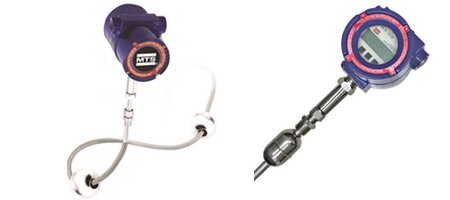
  • Level Transmitter
    Level Transmitter (MTS)
  • PH, conductivity, dissolved gas transmitters, etc. 
Output signals for transmitters, when electrical, often are either voltage (1-5 or 2-10 volts DC) or
current (4-20 mA). Power requirements can vary among products, but are often 110/220 VAC or 24 VDC.  Low power consumption by electrical transmitters can permit some units to be loop powered, operating from the voltage applied to the output current loop. These devices are also called two-wire transmitters because only two conductors are connected to the unit. Unlike the two wire system which only needs two wires to power the transmitter and analog signal output, the four-wire system requires four separate conductors, with one pair serving as the power supply to the unit and a separate pair providing the output signal path. Pneumatic transmitters, while still in use, are continuously being supplanted by electrical units that provide adequate levels of safety and functionality in environments previously only served by pneumatic units.

Temperature and Flow Transmitter
(Fox Thermal Instrument)
Many transmitters are provided with higher order functions in addition to merely converting an input signal to an output signal. On board displays, keypads, Bluetooth connectivity, and a host of industry standard communication protocols can also be had as an integral part of many process transmitters. Other functions that provide alarm or safety action are more frequently part of the transmitter package, as well.

Wireless transmitters are also available, with some operating from battery power and negating the need for any wired connection at all. Process transmitters have evolved from simple signal conversion devices to higher functioning, efficient, easy to apply and maintain instruments utilized for providing input to process control systems.

Industrial Steam Boiler Optimization Toolkit

Steam generation
Steam generation
The primary function of a utility boiler is to convert water into steam to be used by a steam turbine/ generator in producing electricity. The boiler consists of a furnace, where air and fuel are combined and burned to produce combustion gases, and a feedwater tube system, the contents of which are heated by these gases. The tubes are connected to the steam drum, where the generated water vapor is drawn. In larger utility boilers, if superheated steam (low vapor saturation) is to be generated, the steam through the drum is passed through superheated tubes, which are also exposed to combustion gases. Boiler drum pressures can reach 2800 psi with temperatures over 680°F. Small to intermediate size boilers can reach drum pressures between 800 and 900 psi at temperatures of only 520°F if
superheated steam is desired. Small to intermediate size boilers are only being considered for this application note.

Bolier optimizationWith oil‐burning and gas‐burning boiler efficiencies over 90%, power plants are examining all associated processes and controls for efficiency improvements. Between 1 and 3% of the gross work produced by a boiler is used to pump feedwater. One method of improving overall efficiency is by controlling feedwater pump speed to save on pump power.


Read the entire optimization toolkit below (courtesy of Yokogawa).

Tank Level, Interface Level and Temperature Monitoring in a Single Instrument

MTS level transmitters
Level “interface” detection is a common measurement requirement in the oil & gas, food & beverage, bulk storage, chemical, and petrochemical industries.  Interface refers to the separation layer between two liquids in the same tank or vessel. A good example is such as oil and water. Because each liquid has its own density or specific gravity, separation takes place, with the lower density liquid floating on top of the higher density liquid.

Accuracy in detecting the interface is important. Imagine if you were refining oil and had a large tank of crude oil contaminated with water. Knowing where the water layer would be extremely important so it can be separated.

This video provides a quick visual understanding of interface. The instruments shown in the video (from MTS Sensors) are capable of providing accurate tank level measurement, interface level measurement, and also provides temperature measurement.

For more information on level measurement visit http://www.powerspecialties.com or call (816) 353-6550.

Acoustic Wave Technology for Industrial Level Applications

acoustic wave level sensor
Acoustic wave
level sensor by
Hawk Measurement
Acoustic Wave Technology is an improved ultrasonic technic which utilizes lower frequency sound waves. Lower frequencies produce higher power and this power is further enhanced by utilizing a unique piston type transducer.

The transmission of high powered acoustic waves ensures minimal losses through the environment where the sensor is located. Due to the high powered emitted pulse, any losses have far less effect than would be experienced by traditional ultrasonic devices. More energy is transmitted hence more energy is returned. Advanced receiver circuitry is designed to identify and monitor low level return signals even when noise levels are high. The measured signal is temperature compensated to provide maximum accuracy to the outputs and display.

Applications

Level Measurement - Waste water/water:
River level, wet wells, inlet screens, tanks, sumps, pump stations, water towers, dams, basin levels, chemical storage, etc.

Level Measurement - Mining:
Crushers, surge bins, ore passes, conveyor profile, blocked chute, stockpile, stackers, reclaimers, storage silos etc.

Level Measurement - Power Stations:
Boiler bunkers, raw coal bunkers, ash pits, fly ash silos, etc.

Others:
Food, cement, plastics, grain, chemicals, paper, irrigation, quarries

Fundamentals of pH Control in Industrial, Municipal, and Commercial Applications

pH Meter
Handheld pH Meter & Sensor
(courtesy of Yokogawa)
Analytical measurement and control of pH within a system is necessary for many processes. Common applications include food processing, wastewater treatment, pulp & paper production, HVAC, power generation, and chemical industries.

To maintain the desired pH level in a solution, a sensor is used to measure the pH value. If the pH is not at the desired set point, a reagent is applied to the solution. When a high alkaline level is detected in the solution, an acid is added to decrease the pH level. When a low alkaline level is detected in the solution, a base is added to increase the pH level. In both cases the corrective ingredients are called reagents.

Accurately applying the correct amount of reagent to an acid or base solution can be challenging due to the logarithmic characteristics a pH reaction in a solution. Implementing a closed-loop control system maintains the pH level within a certain range and minimizes the degree to which the solution becomes acidic or alkaline.

An example of an automatic pH level control system is a water treatment process where lime softened water is maintained at a pH of 9, using carbon dioxide as a reagent. As the untreated water (or influent) enters the tank, the pH is continuously monitored by the pH sensor. The sensor is the feedback device to the controller where the setpoint is compared to the control value. If the values are not equal, the controller sends a signal to the control valve that applies carbon dioxide to the tank. The reagent is applied to the tank at varying rates to precisely control the pH level. With the pH level at 11 detected by the sensor, the controller commands the control valve to open and introduce more carbon dioxide. As the increased carbon dioxide mixes with the influent, the pH is lowered in a controlled manner. Reaching the setpoint, the carbon dioxide flow is minimized and the process is continually monitored for variation. The effluent is the treated water that is discharged out of the tank. The process continues to provide the lime softened water at the desired pH level.